
Showing posts with label Bible. Show all posts
Showing posts with label Bible. Show all posts
Sunday, November 27, 2016
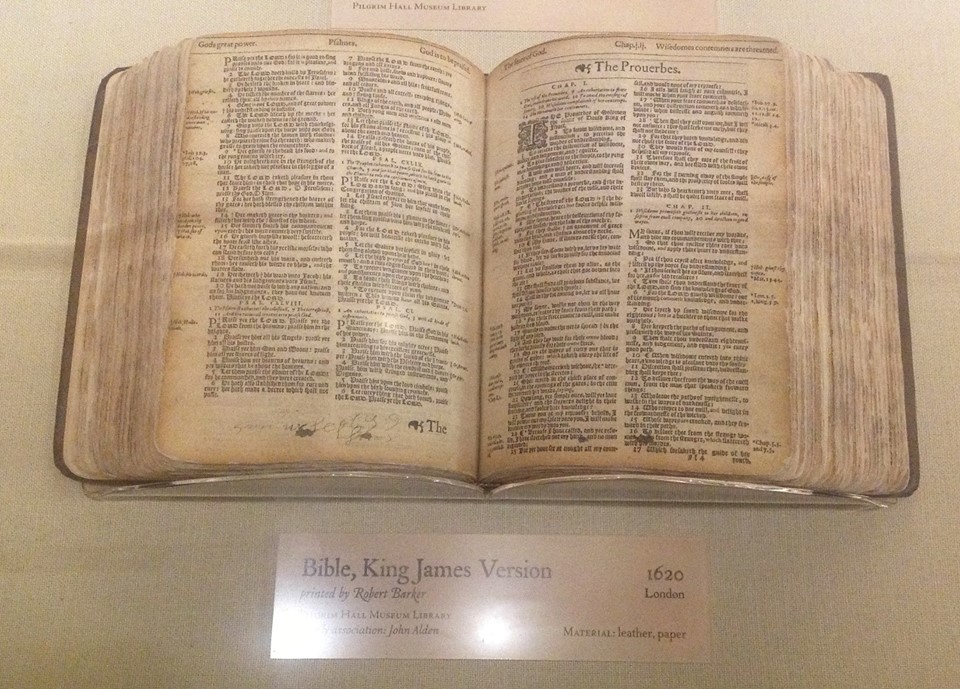
A King James Bible from Plymouth
Happy Thanksgiving to anyone who peruses through here from time to time. I hope your holiday with family has been blessed. Now for a little bit of Bible history: The Geneva Bible has been grandly heralded as the 'Bible of the Pilgrims', which is very true. But - fun fact - the King James Version shown below also landed at Plymouth, owned by non-separatist Mayflower crewmember John Alden. This book now rests in Pilgrim Hall Museum in Massachusetts, alongside William Bradford's personal 1592 Geneva and several other Bibles. Pretty cool!


Monday, November 14, 2016
A Paris Pocket Bible
Compact Medieval books like the "Paris Pocket Bibles" have always fascinated me, and I hope to someday own a facsimile of one (though there are none currently, maybe I should make one...) In the meantime, I shall content myself with pleasant pictures, like the one the The Museum of the Bible posted today as their artifact of the day:

"An interesting little Artifact of the Day: English Pocket Bible from AD 1230-1250. Small “pocket” Bibles were one of the most important book production achievements in the 1200s. While Paris Pocket Bibles evolved in France, England was also an important center of production. English Pocket Bibles were much smaller, such as this one which measures just 4 ¾ inches in height. The start of each chapter has a blue initial, which is distinctively English, compared to others which use both blue and red. Errors found in this manuscript, such as Ezekiel ending imperfectly with the end of Daniel instead, suggests this Bible was copied by more than one scribe."

"An interesting little Artifact of the Day: English Pocket Bible from AD 1230-1250. Small “pocket” Bibles were one of the most important book production achievements in the 1200s. While Paris Pocket Bibles evolved in France, England was also an important center of production. English Pocket Bibles were much smaller, such as this one which measures just 4 ¾ inches in height. The start of each chapter has a blue initial, which is distinctively English, compared to others which use both blue and red. Errors found in this manuscript, such as Ezekiel ending imperfectly with the end of Daniel instead, suggests this Bible was copied by more than one scribe."
Wednesday, May 20, 2015
Today in History: The Council of Nicea

Contrary to popular belief, the Council of Nicea had nothing to do with the canon of the Bible, nor with 'creating' Christianity (both of which are myths perpetuated by a certain Dan Brown book). It was here that the orthodox belief was officially upheld: that Christ was both 100% man and 100% God, and that the Son, while a separate 'person', was of the same substance as the Father. For an accurate and detailed description of the council in layman's terms, I highly recommend Paul Pavao's book Decoding Nicea (which, incidentally, was one of the books that steered me towards the Early Church).
I'll make a longer post on the Nicene Creed sometime soon, since it's the one I adhere to. However, I do believe that Christianity, while growing in size post-Nicea, has decreased in quality. The writings of the Early Church - the writings of the men who sat under the Apostles! - have been largely pushed aside by the Protestant and Evangelical circles. Perhaps the Council's anniversary is just the time to bring up an Early Church discussion with your Christian friends.
Friday, April 10, 2015
Tracing Back the Word "Easter"
This post is not about whether or not we should use the word 'Easter' in place of 'Pascha' or 'Resurrection Sunday'; rather, I wanted to see how far back we could trace the word 'Easter' in translations of the Bible. We see the word "Easter" in Acts 12:4 in the KJV (much to the chagrin of some people), but is that the earliest it appears? Certainly not! For my source text, I elected to use Matthew 26:17-19, since the 'passover words' occur several times there (though not in the KJV).

William Tyndale used 'easter' in a number of places in his 1526 NT translation [his first translation], while at the same time using 'passover' in others. Tyndale apparently used 'passover' and 'easter' interchangeably, with no hinted difference in proposed meaning, and the two can sometimes show up right next to each-other in the text. In the given passage [Mt. 26:17-19] he simply uses easter. His later editions show more polish here than this first edition.

Next we have the same passage in the 1385 Wycliffe Bible, early version. The Middle-English New Testament, based on the Latin Vulgate, uses "paske" [Pascha], which is no surprise because that Greek word remained untranslated in both the Vulgate and the old Vetus Latina. (It's also the word many of us use today in reference to the day of the resurrection.)

The earliest the word 'Easter' actually shows up is in the Anglo-Saxon gospels! Here, we can see 'eastron', 'eastro', and 'easter'. The Old English Gospels used as reference include the Lindisfarne & Wessex Gospels . All three versions I've discussed can be seen side-by-side below.

I have not done any more research into this, but one can conclude that Tyndale used 'Easter' due to its cultural recognizability, and it gave his translation's vocabulary variety. How did it slip into the King James Version though? Likely due to the fact that the passage in Acts occurs after the resurrection, and Christ's fulfillment of the law.
For my reference text, I used The Gothic and Anglo-Saxon Gospels in Parallel Columns with Wycliffe and Tyndale by Henry Bosworth (I shortened the title a tad). You can read the whole passage of Matthew 26, as well as the rest of the gospels in his book here here.
Monday, March 30, 2015
Introduction to Scholarly Bible Editions
"Textual Research on the Bible: An Introduction to the Scholarly Editions of the German Bible Society" is an excellent little booklet recently released by the Society of Biblical Literature. Inside is a concise but informative summary of all the major Hebrew and Greek Bible texts published by the German Bible Society in the last hundred years or so, along with related information on the history of textual criticism in general. Since these are the primary source texts of countless Biblical language students, I recommend acquiring a copy of this booklet and keeping it handy for reference. A short read, and great pictures too! The sections include:
1. What is Old Testament Textual Research?
I. The Biblia Hebraica by Rudolf Kittel (BHK)
II. The Biblia Hebraica Stuttgartensia (BHS)
III. The Future of the Biblia Hebraica
2. What is New Testament Textual Research?
I. The Nestle-Aland Novum Testamentum Graece and Its History
II. The Greek New Testament and Its History
III. The Significance of the Two Editions Today
IV. The Outlook: New Testament Textual Research Continues
You can download or simply view the PDF version here:
https://www.sbl-site.org/assets/pdfs/Intro-ScholarlyEditions-GBS_2.pdf
1. What is Old Testament Textual Research?
I. The Biblia Hebraica by Rudolf Kittel (BHK)
II. The Biblia Hebraica Stuttgartensia (BHS)
III. The Future of the Biblia Hebraica
2. What is New Testament Textual Research?
I. The Nestle-Aland Novum Testamentum Graece and Its History
II. The Greek New Testament and Its History
III. The Significance of the Two Editions Today
IV. The Outlook: New Testament Textual Research Continues
You can download or simply view the PDF version here:
https://www.sbl-site.org/assets/pdfs/Intro-ScholarlyEditions-GBS_2.pdf
Friday, January 30, 2015
Having a bad day? Scribes did too.

 The monk or scribe that worked on this text was having a really bad day. In the source manuscript being copied down, the Gospel of Luke chapter 3 [the genealogy of Jesus] was in a two-column format (like most Bibles today). Unfortunately, the scribe seems to have copied the text as if it were one single column. He may have gotten lazy, or more likely, could not understand or comprehend the language that he was transcribing. The result was a genealogical mishmash, and it gave everyone in the passage the the wrong father. In fact, the scribe goofed in such a way that the text makes Phares the creator of the world, and God was made the son of Aram. In any case, the mistake is one that has far outlived the original author... The moral of the story? On the rougher days, it is especially important to pay attention to what you are doing!
Monday, December 29, 2014
The Earliest Image of the Cross
The holiday season has come and almost gone, and with new year around the corner, I decided I should try to fit one more blog post in before 2014 ends. (I'm not very timely when it comes to writing these up.)
I recently crossed paths with a fascinating article from the Centre for Public Christianity regarding the earliest images of the cross. While historical research has shown that depictions of the cross in church decorations and jewelry did not become prevalent until after the fourth century, there were actually symbolic likenesses of the cross as early as 200 AD in papyrus manuscripts of the New Testament.

I recently crossed paths with a fascinating article from the Centre for Public Christianity regarding the earliest images of the cross. While historical research has shown that depictions of the cross in church decorations and jewelry did not become prevalent until after the fourth century, there were actually symbolic likenesses of the cross as early as 200 AD in papyrus manuscripts of the New Testament.
According to the article, scribes "took the letter ‘t’ (written in Greek as Τ) and the letter ‘r’ (written in Greek as Ρ) and ingeniously laid them on top of each other to form what looks like a man on a cross. The image below is from a manuscript of Luke’s Gospel known as P75, dated to about AD200. The ‘staurogram’, as it is called, is clearly visible."
The image of the cross is everywhere in Christian society today, but it's nice to see that the symbolism goes back further than we previously were taught. You can read the article in its entirety here: http://publicchristianity.org/opinion/the-first-image-of-the-cross#.VJ0fhsAEN
Saturday, June 14, 2014
Tertullian on the Logos
"In the beginning was the Logos, and the Logos was with God, and the Logos was God... And the Logos became flesh and dwelt among us, and we beheld His glory, the glory as of the only begotten of the Father, full of grace and truth." - John 1:1, 14 [NKJV]
Most English Bibles today translate the Greek term Logos as 'word', though it can also mean 'reason', 'thought', 'mind', 'message', and 'wisdom'. God imparted His Logos to the fallen physical world in the form of the Messiah, Jesus Christ of Nazareth, and through His sacrifice laid upon Him the sins of the world, saving all those who believe and call upon His name. [Isaiah 53:6, Acts 16:31]

Crafting a clear and solid description of the Logos, however, can be a daunting task, but the writings of the Apostolic Fathers can provide excellent answers for such questions.
I recently finished Paul Pavao's excellent book, In the Beginning was the Logos: The Council of Nicea for Everyman, which earns my accolades as one of the clearest and most accessible books ever written about the history and theology of the early church. Chapter 17 deals wholly with the discussion of the Trinity and the Logos, not just at the Council of Nicea, but also in written works throughout the first several centuries of Christianity. Pages 316-318 highlight some of the fantastic words of Tertullian (c. 160 - c. 225 AD), whose work Against Praxeas describes the Logos in relation to God:
"Observe, then, that when you are silently conversing with yourself, this very process is carried on within you by your reason, which meets you with a word at every movement of your thought... Whatever you think, there is a word... You must speak it in your mind."[5]
 "I would not hesitate... to call a tree the son or offspring of the root, and the river of the spring, and the ray of the sun. Every original source is a parent, and everything which issues from the origin is an offspring. Much more is the Word of God, who has actually received as his own peculiar designation the name of Son."
"But still the tree is not severed from the root, nor the river from the spring, nor the ray from the sun. Nor, indeed, is the Word [Logos] separated from God."
"Following, therefore, the form of these analogies, I confess that I call God and his Word, the Father and his Son, two. For the root and the tree are distinctly two things, but correlatively joined. The spring and the river are also two forms, but indivisible. So likewise the sun and the ray are two forms, but coherent ones." [8]
----------
Pavao summarizes Tertullian's view on his page devoted to the Early Christian Definition of the Trinity as the following: "In other words, there was a time when the Logos of God was inside of God. God was alone, but he had fellowship with his own Logos inside of him. When it was time to create the world, it was then that God birthed the Word as the second person of the Trinity."
It is worth noting that Tertullian was the first theologian to use the word "Trinity" (in Latin, Trinitas), though a similar term had been used earlier by Theophilus of Antioch, being the Greek word Triados.
Most English Bibles today translate the Greek term Logos as 'word', though it can also mean 'reason', 'thought', 'mind', 'message', and 'wisdom'. God imparted His Logos to the fallen physical world in the form of the Messiah, Jesus Christ of Nazareth, and through His sacrifice laid upon Him the sins of the world, saving all those who believe and call upon His name. [Isaiah 53:6, Acts 16:31]
Crafting a clear and solid description of the Logos, however, can be a daunting task, but the writings of the Apostolic Fathers can provide excellent answers for such questions.
I recently finished Paul Pavao's excellent book, In the Beginning was the Logos: The Council of Nicea for Everyman, which earns my accolades as one of the clearest and most accessible books ever written about the history and theology of the early church. Chapter 17 deals wholly with the discussion of the Trinity and the Logos, not just at the Council of Nicea, but also in written works throughout the first several centuries of Christianity. Pages 316-318 highlight some of the fantastic words of Tertullian (c. 160 - c. 225 AD), whose work Against Praxeas describes the Logos in relation to God:
"Observe, then, that when you are silently conversing with yourself, this very process is carried on within you by your reason, which meets you with a word at every movement of your thought... Whatever you think, there is a word... You must speak it in your mind."[5]
"But still the tree is not severed from the root, nor the river from the spring, nor the ray from the sun. Nor, indeed, is the Word [Logos] separated from God."
"Following, therefore, the form of these analogies, I confess that I call God and his Word, the Father and his Son, two. For the root and the tree are distinctly two things, but correlatively joined. The spring and the river are also two forms, but indivisible. So likewise the sun and the ray are two forms, but coherent ones." [8]
----------
Pavao summarizes Tertullian's view on his page devoted to the Early Christian Definition of the Trinity as the following: "In other words, there was a time when the Logos of God was inside of God. God was alone, but he had fellowship with his own Logos inside of him. When it was time to create the world, it was then that God birthed the Word as the second person of the Trinity."
It is worth noting that Tertullian was the first theologian to use the word "Trinity" (in Latin, Trinitas), though a similar term had been used earlier by Theophilus of Antioch, being the Greek word Triados.
Thursday, May 22, 2014
A Word to Awana Citation Achievers
Last Wednesday, I had the privilege of watching several high school seniors receive their Awana Citation Awards. These young men and women successfully finished their time as Awana clubbers, representing 10 years of Bible memorization, teamwork activities, service work, and various special projects. The journey towards a Citation Award starts in 3rd grade, the first year of Awana's Truth & Training club, and continues through the Trek (7th and 8th grade) and Journey (high school) clubs.
From the Awana website:
 A teenager earning the Citation Award must be
a graduating senior. Adults can also earn the Citation. In completing
the award requirements, the achiever will have memorised 836 verses,
read the entire Bible and completed the 10 third- through 12th-grade
handbooks and manuals.
A teenager earning the Citation Award must be
a graduating senior. Adults can also earn the Citation. In completing
the award requirements, the achiever will have memorised 836 verses,
read the entire Bible and completed the 10 third- through 12th-grade
handbooks and manuals.
I earned my Citation Award in May 2008, and I still remember exactly what being on stage and receiving it felt like. Would that all Awana boys and girls could strive for such a moment! The Citation is recognised as a prestigious award by many churches and organisations, and a number of Christian colleges and universities award various scholarships to students who have earned one. (As a note, mine earned me $1000 per year at San Diego Christian College.)
During my final year at Awana camp as a camper, the senior's teacher (a certain Mr. Houser,) gave us all some sage advice:
A Citation award is a tool.
Some tools are earned/bought/received, and then stored in the shed indefinitely. Others are used often at first, but then gradually forgotten about. Others are tossed aside after a period of time, seen as archaic or useless.
But, some tool are appreciated, and recognised for their usefulness, and are utilised often for the betterment of their owners life, and the lives of those around him. Will you leave your tool to rust in the shed? Or will you find uses for it in the situations that life presents?

That parable struck a chord with me; I've never forgotten it, and its truths are more and more evident with the passage of time.
Of the many fellow clubbers who I've seen earn Citation, some have fallen away, shunning Christianity and the life that the Lord offered them, preferring to pursue the countless and stark attractions of sin. Others have sought to serve two masters, joining their fleshly desires with their faith, and are enduring harsh consequences in an impossible lifestyle. These are people that I saw as my peers, and some I even looked up to. Such is the way of the world; God does not change, and His Word (both the Bible and the Logos Himself) warned us of such individuals.
But there's always a bright side: For every Citation earner who has fallen away, there are many more still that have risen to the challenge and continued on the paths of righteousness, paths that God has laid out and offered to them since the beginning of time. Some serve in their churches as leaders and pastors. Others serve their community as firefighters, law enforcement, and in the military and other government service positions. Some serve as missionaries in far-flung countries, while others travel to their 'lowly' office or job site every day, knowing that the Lord has given them the opportunity to minister and be an example, like many apostles, in the Agora --- the busy markets and places of exchange.
There are lawyers, doctors, teachers, salesmen, chefs, and construction workers who share the achievement that sets you and them apart as leaders in the Body of Christ. Finally, some are pursuing the toughest occupation of all: Raising Godly children in an increasingly hostile world. It is these people who chase after the highest calling, and the one with perhaps the greatest earthly rewards.

In essence, here is my message to Citation earners, from one Awana alumnus to another:
Your Citation award is a tool, perhaps one of the greatest tools of your young life. The 'tool' portion is not the award itself - in all its monogrammed plastic glory - but rather the journey of the countless Bible verses and studies you've endured. Few Christians have the training you now possess, and fewer still have the grasp of the Bible that have obtained. Follow the path of righteousness the Lord has laid out for you, and it will be there for you when the need to use it arises. Whether your mission field is a third-world country, a business office, or a classroom, the Holy Spirit will bring to mind the verses you memorised, and that will open the doors for sharing your faith in Christ. Though your friends and fellow earners may fall away, stay strong in the Lord and in the power of His might.
A related word of advice: If and when your friends and fellow Citation earners do fall away, do not shun them and throw them out of fellowship with you. Instead, continue to act as a beacon of light in their lives. Unless they completely shun you, you are still their friend! Christianity may come to seem foolish in their minds, but continue to exude the love of Christ, and the wisdom granted to us via the Holy Spirit. Keep a vigilant watch over your actions and deeds, lest you be seen as a hypocrite, for even though we may not think it, we are each witnesses and missionaries to those around us.
We all make mistakes and sin, but the mercy we receive, coupled with a heartfelt yearning to repent, is what has given us the ultimate freedom of Life.
To that end, your 'award' marks the beginning of a term of service to fellow believers. You are armed with the truth, the power, and the light: Follow Jesus Christ's command in Matthew 20, and be a Servus Servorum Dei --- a Servant of the Servants of God.
The road to your Citation was about the journey, not the destination. It's a piece of plastic; never let its true value become clouded or lost on you!
1 Timothy 4:10-12 NKJV
For to this end we both labor and suffer reproach, because we trust in the living God, who is the Savior of all men, especially of those who believe. These things command and teach. Let no one despise your youth, but be an example to the believers in word, in conduct, in love, in spirit, in faith, in purity.
1 Peter 3:15 NKJV
But sanctify the Lord God in your hearts, and always be ready to give a defense to everyone who asks you a reason for the hope that is in you, with meekness and fear.
From the Awana website:
A teenager earning the Citation Award must be
a graduating senior. Adults can also earn the Citation. In completing
the award requirements, the achiever will have memorised 836 verses,
read the entire Bible and completed the 10 third- through 12th-grade
handbooks and manuals.I earned my Citation Award in May 2008, and I still remember exactly what being on stage and receiving it felt like. Would that all Awana boys and girls could strive for such a moment! The Citation is recognised as a prestigious award by many churches and organisations, and a number of Christian colleges and universities award various scholarships to students who have earned one. (As a note, mine earned me $1000 per year at San Diego Christian College.)
During my final year at Awana camp as a camper, the senior's teacher (a certain Mr. Houser,) gave us all some sage advice:
A Citation award is a tool.
Some tools are earned/bought/received, and then stored in the shed indefinitely. Others are used often at first, but then gradually forgotten about. Others are tossed aside after a period of time, seen as archaic or useless.
But, some tool are appreciated, and recognised for their usefulness, and are utilised often for the betterment of their owners life, and the lives of those around him. Will you leave your tool to rust in the shed? Or will you find uses for it in the situations that life presents?
That parable struck a chord with me; I've never forgotten it, and its truths are more and more evident with the passage of time.
Of the many fellow clubbers who I've seen earn Citation, some have fallen away, shunning Christianity and the life that the Lord offered them, preferring to pursue the countless and stark attractions of sin. Others have sought to serve two masters, joining their fleshly desires with their faith, and are enduring harsh consequences in an impossible lifestyle. These are people that I saw as my peers, and some I even looked up to. Such is the way of the world; God does not change, and His Word (both the Bible and the Logos Himself) warned us of such individuals.
But there's always a bright side: For every Citation earner who has fallen away, there are many more still that have risen to the challenge and continued on the paths of righteousness, paths that God has laid out and offered to them since the beginning of time. Some serve in their churches as leaders and pastors. Others serve their community as firefighters, law enforcement, and in the military and other government service positions. Some serve as missionaries in far-flung countries, while others travel to their 'lowly' office or job site every day, knowing that the Lord has given them the opportunity to minister and be an example, like many apostles, in the Agora --- the busy markets and places of exchange.
There are lawyers, doctors, teachers, salesmen, chefs, and construction workers who share the achievement that sets you and them apart as leaders in the Body of Christ. Finally, some are pursuing the toughest occupation of all: Raising Godly children in an increasingly hostile world. It is these people who chase after the highest calling, and the one with perhaps the greatest earthly rewards.
In essence, here is my message to Citation earners, from one Awana alumnus to another:
Your Citation award is a tool, perhaps one of the greatest tools of your young life. The 'tool' portion is not the award itself - in all its monogrammed plastic glory - but rather the journey of the countless Bible verses and studies you've endured. Few Christians have the training you now possess, and fewer still have the grasp of the Bible that have obtained. Follow the path of righteousness the Lord has laid out for you, and it will be there for you when the need to use it arises. Whether your mission field is a third-world country, a business office, or a classroom, the Holy Spirit will bring to mind the verses you memorised, and that will open the doors for sharing your faith in Christ. Though your friends and fellow earners may fall away, stay strong in the Lord and in the power of His might.
A related word of advice: If and when your friends and fellow Citation earners do fall away, do not shun them and throw them out of fellowship with you. Instead, continue to act as a beacon of light in their lives. Unless they completely shun you, you are still their friend! Christianity may come to seem foolish in their minds, but continue to exude the love of Christ, and the wisdom granted to us via the Holy Spirit. Keep a vigilant watch over your actions and deeds, lest you be seen as a hypocrite, for even though we may not think it, we are each witnesses and missionaries to those around us.
We all make mistakes and sin, but the mercy we receive, coupled with a heartfelt yearning to repent, is what has given us the ultimate freedom of Life.
To that end, your 'award' marks the beginning of a term of service to fellow believers. You are armed with the truth, the power, and the light: Follow Jesus Christ's command in Matthew 20, and be a Servus Servorum Dei --- a Servant of the Servants of God.
The road to your Citation was about the journey, not the destination. It's a piece of plastic; never let its true value become clouded or lost on you!
1 Timothy 4:10-12 NKJV
For to this end we both labor and suffer reproach, because we trust in the living God, who is the Savior of all men, especially of those who believe. These things command and teach. Let no one despise your youth, but be an example to the believers in word, in conduct, in love, in spirit, in faith, in purity.
1 Peter 3:15 NKJV
But sanctify the Lord God in your hearts, and always be ready to give a defense to everyone who asks you a reason for the hope that is in you, with meekness and fear.
Wednesday, April 2, 2014
The Evangelists and Their Sources
Here's another interesting introductory document, The Evangelists and Their Sources by Irenaeus, Bishop of Lyons in the late 2nd century. Though some of the actual historicity of these statements may be debatable, this provides a concise and informative history of the Gospels and their authors from the proto-orthodox period:

"Matthew published his gospel among the Hebrews in their own tongue [Aramaic], when Peter and Paul were preaching the Gospel in Rome and founding the church there. After their departure, Mark, the disciple and interpreter of Peter, himself handed down to us in writing the substance of Peter's preaching. Luke, the follower of Paul, set down in a book the gospel preached by his teacher. Then John, the disciple of the Lord, who also leaned on his breast, himself produced his gospel, while he was living at Ephesus in Asia [Minor]. If anyone does not agree to these truths, he despises the companions of the Lord... He despises the Father also, and stands self-condemned, resisting and opposing his own salvation." [Against Heresies III:1:1]
"Matthew published his gospel among the Hebrews in their own tongue [Aramaic], when Peter and Paul were preaching the Gospel in Rome and founding the church there. After their departure, Mark, the disciple and interpreter of Peter, himself handed down to us in writing the substance of Peter's preaching. Luke, the follower of Paul, set down in a book the gospel preached by his teacher. Then John, the disciple of the Lord, who also leaned on his breast, himself produced his gospel, while he was living at Ephesus in Asia [Minor]. If anyone does not agree to these truths, he despises the companions of the Lord... He despises the Father also, and stands self-condemned, resisting and opposing his own salvation." [Against Heresies III:1:1]
Friday, March 28, 2014
The Didache on: The Weekly Meeting
On the heels of my last post, the weekly meeting of the church is also mentioned in The Didache, in a concise form that differs with Justin Martyr's description. As a note, The Didache - also known as The Teachings of the Twelve Apostles - was first discovered in manuscript form inside a monastery in Constantinople, in 1883. Written sometime between the late 1st and early 3rd centuries, the document likely served as a handbook for new Christians, outlining the lifestyle necessary for church membership. In his Festal Letter [39:7], Athanasius declares The Didache to be among the list of books "not included in the [Biblical] Canon, but appointed by the Fathers to be read by those who newly join us, and who wish for instruction in the word of godliness." This particular chapter would be an introduction to the church meeting, rather than a in-depth account.
 On the Lord's own day gather together and break bread and give thanks, having first confessed your sins so that your sacrifice may be pure. But let no one who has a quarrel with a companion join you until they have been reconciled, so that your sacrifice may not be defiled. For this is the sacrifice concerning which the Lord said, "In every place and time offer me a pure sacrifice, for I am a great king, says the Lord, and my name is marvelous among the nations [Malachi 1:11, 14]."
"Concerning the Lord's Day"
from chapter XIV of The Didache
Thursday, March 20, 2014
The Weekly Meeting, circa 150 AD...
What did 'going to church' look like in Christianity's first 100 years or so? Obviously the book of Acts is our best source, but I was browsing through Henry Bettenson's Documents of the Christian Church and stumbled across a concise passage describing the weekly meeting of Christians during the 2nd century. If this description sounds similar to your church/congregation/fellowship services, you're probably on a good path.
"Now we always thereafter remind one another of these things; and those that have the means assist them that are in need, and we visit one another continually. And at all our meals we bless the maker of all things through his son Jesus Christ and through the Holy Ghost."
"And on the day which is called the day of the sun, there is an assembly of all who live in the towns or in the country; and the memoirs of the Apostles or the writings of the prophets are read, as long as time permits. Then the reader ceases, and the president speaks, admonishing us and exhorting us to to imitate these excellent examples. Then we arise all together and offer prayers; and as said before, when we have concluded our prayer, bread is brought, and wine and water, and the president in like manner offers up prayers and thanksgivings with all his might; and the people assent with "Amen"; and there is the distribution and partaking by all of the Eucharistic elements; and to them that are not present they are sent by the hand of the deacons. And they that are prosperous and wish to do so give what they will, each after his choice. What is collected is deposited with the president, who gives aid to the orphans and widows, and as such as are in want by reason of sickness or other cause; and to those also that are in prison, and to strangers from abroad, in fact to all that are in need he is a protector."
"We hold our common assembly on the day of the sun, because it is the first day, on which God put to flight darkness and chaos and made the world, and on the same day Jesus Christ our saviour rose from the dead; for on the day before that of Saturn they crucified him; and on the day after Saturn's day, the day of the sun, he appeared to his Apostles and disciples and taught them these things, which we have also handed on to you for your consideration."

Thus, as tradition, documents, other historical writings dictate, members of the Christian community met on Sunday in one building or another, typically someone's home or a public or private meeting area. (There was no 'church' per se, because the body of believers IS 'the church', something Lollards fiercely adhere to.) There, they would:
- Read passages of the Old and New Testaments for "as long as time permits."
- Have the chief elder [president/presbyter] teach and exhort those present to follow the examples from the passages that had just been read.
- Have public prayer.
- Have communion.
- Take an offering for the orphans, widows, the sick and imprisoned, and other friends and strangers in need.
"Weekly Worship of Christians"
from chapter LXVII [67] of Justin Marty's Apology:
"Now we always thereafter remind one another of these things; and those that have the means assist them that are in need, and we visit one another continually. And at all our meals we bless the maker of all things through his son Jesus Christ and through the Holy Ghost."
"And on the day which is called the day of the sun, there is an assembly of all who live in the towns or in the country; and the memoirs of the Apostles or the writings of the prophets are read, as long as time permits. Then the reader ceases, and the president speaks, admonishing us and exhorting us to to imitate these excellent examples. Then we arise all together and offer prayers; and as said before, when we have concluded our prayer, bread is brought, and wine and water, and the president in like manner offers up prayers and thanksgivings with all his might; and the people assent with "Amen"; and there is the distribution and partaking by all of the Eucharistic elements; and to them that are not present they are sent by the hand of the deacons. And they that are prosperous and wish to do so give what they will, each after his choice. What is collected is deposited with the president, who gives aid to the orphans and widows, and as such as are in want by reason of sickness or other cause; and to those also that are in prison, and to strangers from abroad, in fact to all that are in need he is a protector."
"We hold our common assembly on the day of the sun, because it is the first day, on which God put to flight darkness and chaos and made the world, and on the same day Jesus Christ our saviour rose from the dead; for on the day before that of Saturn they crucified him; and on the day after Saturn's day, the day of the sun, he appeared to his Apostles and disciples and taught them these things, which we have also handed on to you for your consideration."
Thus, as tradition, documents, other historical writings dictate, members of the Christian community met on Sunday in one building or another, typically someone's home or a public or private meeting area. (There was no 'church' per se, because the body of believers IS 'the church', something Lollards fiercely adhere to.) There, they would:
- Read passages of the Old and New Testaments for "as long as time permits."
- Have the chief elder [president/presbyter] teach and exhort those present to follow the examples from the passages that had just been read.
- Have public prayer.
- Have communion.
- Take an offering for the orphans, widows, the sick and imprisoned, and other friends and strangers in need.
Wednesday, February 19, 2014
Erasmus on Greek and Bible Translation

"How is it that Jerome [c.347-420 AD, translator and compiler of the original Vulgate], Augustine, and Ambrose all cite a text which differs from the [current] Vulgate? How is it that Jerome finds fault with and corrects many readings which we find in the Vulgate? What can you make of all this concurrent evidence - when the Greek versions differ from the Vulgate, when Jerome cites the text, according to the Greek versions, when the oldest Latin versions [Vetus Latina] do the same, when this reading suits the sense much better than that of the Vulgate - will you, treating all this with contempt, follow a version corrupted by some copyists?"
Erasmus also recognised that Latin was on the decline, and to hide the secrets of God's Holy Word away in a language known only to a few was a travesty. Many laymen heard short passages of the Vulgate during the mass - together with the usual orthodox interpretation - but there was no freedom to fully comprehend the intricacies of God's Word in the vernacular. While he did not personally engage in translating the Bible into any vernacular languages, Erasmus encouraged those brave individuals who did so, via his books and private letters. By the early years of the English Reformation, his Bible paraphrases and commentaries were translated into English and placed alongside the Bible in every church in England. In the preface to one of the editions of his Novum Testamentum, the scholar wrote:
"I wish that even the weakest woman should read the Gospel – should read the epistles of Paul. And I wish these were translated into all languages, so that they might be read and understood, not only by the Scots and Irishmen, but also by Turks and Saracens. To make them understood is surely the first step. It may be that they might be ridiculed by many, but some would take them to heart. I long that the husbandman should sing portions of them to himself as he follows the plough, that the weaver should hum them to the tune of his shuttle, that the traveller should beguile with their stories the tedium of his journey."
Those sentences in the middle regarding translating the Bible stand out to me the most: "To make them understood is surely the first step. It may be that they might be ridiculed by many, but some would take them to heart."
Of course there will always be men and women that shun the Bible, and (as the Catholic Church in the Middle Ages feared,) poke fun at it in taverns, inns, meeting halls, marketplaces, and in their private chambers. However, that is between them and the Lord, and the fact is that some of those men and women will hear and read the truth, and the truth will set them free. It is a personal decision that cannot be forced, nor denied by any group on earth. For that reason the Lollards spread the Gospel and gave their handwritten Middle English manuscripts to the laity; and it is for that reason Erasmus's writings inspired William Tyndale, Martin Luther, and others to translate the Greek and Hebrew testaments into the languages of their people, so that all may be able to choose to make their own personal conscious decision for Christ.
Quote sources: How Our Bible Came To Us by H.G.G. Herklots
Monday, February 3, 2014
Source Manuscripts of Erasmus's Greek New Testament
Here's some information I have reprinted from a previous blog of mine:

In 1516, Desiderius Erasmus published Novum Istrumentum Omne - the first printed Greek New Testament, and perhaps the crowning achievement of the Dutch Catholic Humanist's life. At the behest of printer Johann Froben, the work was rushed out, in competition with Cardinal Francisco Ximenez' Complutensian Polyglot, and was unfortunately riddled with printing and translation errors.
Despite issues, the tome was well received by the academic community, but scorned by many ecclesiastical authorities, citing its many departures from Latin Vulgate. Erasmus claimed that his goal in the creation of his 'New Instrument' was to revive critical interest in the Bible, whose dated 4th century Latin should updated to its original language of Greek (with a translation into Classical Latin placed alongside). Long-venerated, only recently have historians been able to examine just where much of the text originated.
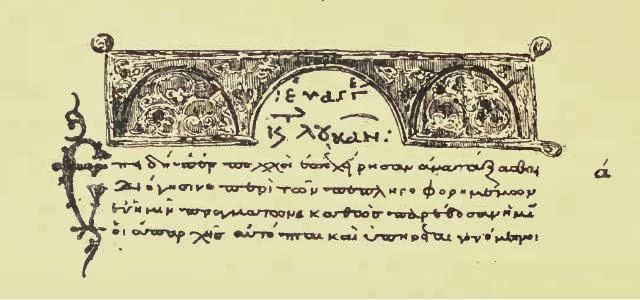
Most King James Version Only'ist websites state that Erasmus (who gave us the base text of the King James Version,) used "the best manuscripts in European libraries" for his Novum Instrumentum. Research has shown that this assertion is debatable. Historian W.W. Combs, in his article "Erasmus and the Textus Receptus" (Spring 1996 Detroit Baptist Seminary Journal) asserts that Erasmus only borrowed seven manuscripts altogether, all from the Dominican library in Basel, Switzerland. None were the complete New Testament, and all were relatively young in age:
*Name, content, date.*
Codex 1eap (entire New Testament except Revelation, 12th century, pic above)
Codex 1rK (book of Revelation, 12th century)
Codex 2e (Gospels, 12th century)
Codex 2ap (Acts and Epistles, 12th century)
Codex 4ap (Pauline Epistles, 12th century)
Codex 7p (Pauline Epistles, 12th century)
Codex 817 (Gospels, 15th century)
The origins of all seven of these manuscripts cannot be fully deduced, but there are a handful of records that point to a few. John of Ragusa, a Dominican friar who visited Basel for one of the church councils in 1431, reportedly gifted three manuscripts to the Dominican convent at which he had lodged. Two more codices may have been on loan from the library at St. Paul's. The rest had likely been in collection at Basel for some time.
When Codex 1r (and possibly others) was missing sections, Erasmus lifted those passages from the Latin Vulgate, translated them into Greek, and inserted them into his text. This is a hotly contested choice even today, and is the source of much contention between the KJVOnlyists and the Anti-KJVOnlyists. In any case, Erasmus heavily edited his work, and subsequent editions were far more solid. Notably, the 2nd edition was used by Martin Luther in translating his 1522 German New Testament, and the 3rd edition was used by William Tyndale in his 1526 English New Testament (whose text survived despite heavy Catholic persecution, and 80% of which was carried over into the KJV's New Testament). The 3rd, 4th, and 5th editions were utilised in Robert Estienne's 1551 Editio Regia - the Textus Receptus that would serve as the primary Greek New Testament source for the next several hundred years.
In 1516, Desiderius Erasmus published Novum Istrumentum Omne - the first printed Greek New Testament, and perhaps the crowning achievement of the Dutch Catholic Humanist's life. At the behest of printer Johann Froben, the work was rushed out, in competition with Cardinal Francisco Ximenez' Complutensian Polyglot, and was unfortunately riddled with printing and translation errors.
Despite issues, the tome was well received by the academic community, but scorned by many ecclesiastical authorities, citing its many departures from Latin Vulgate. Erasmus claimed that his goal in the creation of his 'New Instrument' was to revive critical interest in the Bible, whose dated 4th century Latin should updated to its original language of Greek (with a translation into Classical Latin placed alongside). Long-venerated, only recently have historians been able to examine just where much of the text originated.
Most King James Version Only'ist websites state that Erasmus (who gave us the base text of the King James Version,) used "the best manuscripts in European libraries" for his Novum Instrumentum. Research has shown that this assertion is debatable. Historian W.W. Combs, in his article "Erasmus and the Textus Receptus" (Spring 1996 Detroit Baptist Seminary Journal) asserts that Erasmus only borrowed seven manuscripts altogether, all from the Dominican library in Basel, Switzerland. None were the complete New Testament, and all were relatively young in age:
*Name, content, date.*
Codex 1eap (entire New Testament except Revelation, 12th century, pic above)
Codex 1rK (book of Revelation, 12th century)
Codex 2e (Gospels, 12th century)
Codex 2ap (Acts and Epistles, 12th century)
Codex 4ap (Pauline Epistles, 12th century)
Codex 7p (Pauline Epistles, 12th century)
Codex 817 (Gospels, 15th century)
The origins of all seven of these manuscripts cannot be fully deduced, but there are a handful of records that point to a few. John of Ragusa, a Dominican friar who visited Basel for one of the church councils in 1431, reportedly gifted three manuscripts to the Dominican convent at which he had lodged. Two more codices may have been on loan from the library at St. Paul's. The rest had likely been in collection at Basel for some time.
When Codex 1r (and possibly others) was missing sections, Erasmus lifted those passages from the Latin Vulgate, translated them into Greek, and inserted them into his text. This is a hotly contested choice even today, and is the source of much contention between the KJVOnlyists and the Anti-KJVOnlyists. In any case, Erasmus heavily edited his work, and subsequent editions were far more solid. Notably, the 2nd edition was used by Martin Luther in translating his 1522 German New Testament, and the 3rd edition was used by William Tyndale in his 1526 English New Testament (whose text survived despite heavy Catholic persecution, and 80% of which was carried over into the KJV's New Testament). The 3rd, 4th, and 5th editions were utilised in Robert Estienne's 1551 Editio Regia - the Textus Receptus that would serve as the primary Greek New Testament source for the next several hundred years.
Sunday, February 2, 2014
Layout of Bible Codices


Scripture typically looked like the text here, taken from Acts chapter 2. As a note, our current chapter divisions were not put in until 1205 AD, under the supervision of Archbishop of Canterbury Stephen Langton. Modern verse divisions were first inserted by Robert Estienne (aka Stephanus) in the 1551 edition of his Greek New Testament.
I personally exhort fellow Christians to find a Bible that does not have any verse divisions and read through a gospel or letter in one sitting; this is the way they were 'meant' to be read, and I often get more out of those books than I do when I just read a short passage. There's not many editions like this out there, but their number is increasing.
Some Bibles without verse divisions:
- The Reader's Digest Condensed Bible (RSV)
- ESV Reader's Bible
- The Books of the Bible (NIV 2011)
- Any historical facsimile of a Bible version from the mid-1500s or prior.
Subscribe to:
Posts (Atom)