Showing posts with label History. Show all posts

Sunday, July 23, 2017

Recent Activity and The 95 Theses

       It's been quite a few months since my last post, but 2017 has been an exceptionally busy year. The school I teach at has moved to a much larger campus, increasing our number of students and my duties as well. While I come on here pretty frequently and stare at my blog, I simply haven't had anything notable to add. Rather, I've been in an intense 'learning mode' this year. With October marking the 500th anniversary of the beginning of the Protestant Reformation, I decided I needed to re-visit the writings of the Reformers (and not just read 'about' them as I have been in the past). I've made my way through many of the writings of Erasmus, More, Luther, Tyndale, and am soon moving on to Calvin. I hope to make some posts about Reformation writings in the near future, but for now I am simply ingesting all I can. 
       On a related note, here's a great post from Luther in Oxford on the three oldest prints of Martin Luther's 95 Theses. With the originals being lost to time, these sheets are probably the closest we'll ever get what Luther nailed to the church door in Wittenberg (if he ever actually did that!). 
https://lutherinoxford.wordpress.com/2016/05/20/the-three-oldest-prints-of-martin-luthers-ninety-five-theses/

Sunday, November 27, 2016

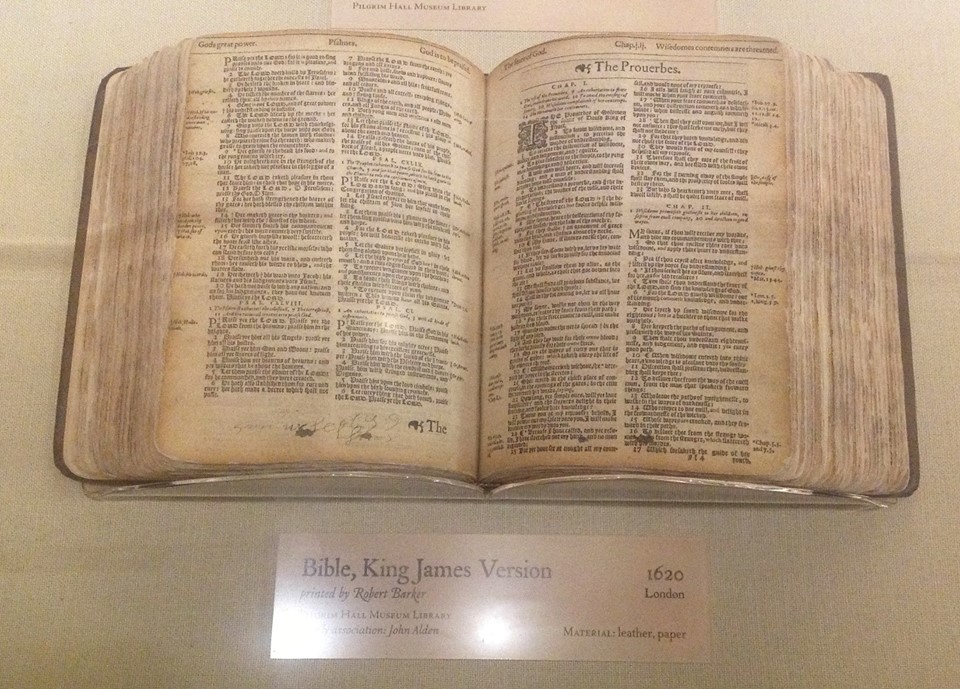
A King James Bible from Plymouth

       Happy Thanksgiving to anyone who peruses through here from time to time. I hope your holiday with family has been blessed. Now for a little bit of Bible history: The Geneva Bible has been grandly heralded as the 'Bible of the Pilgrims', which is very true. But - fun fact - the King James Version shown below also landed at Plymouth, owned by non-separatist Mayflower crewmember John Alden. This book now rests in Pilgrim Hall Museum in Massachusetts, alongside William Bradford's personal 1592 Geneva and several other Bibles. Pretty cool!

Monday, November 14, 2016

A Paris Pocket Bible

       Compact Medieval books like the "Paris Pocket Bibles" have always fascinated me, and I hope to someday own a facsimile of one (though there are none currently, maybe I should make one...) In the meantime, I shall content myself with pleasant pictures, like the one the The Museum of the Bible posted today as their artifact of the day:

       "An interesting little Artifact of the Day: English Pocket Bible from AD 1230-1250. Small “pocket” Bibles were one of the most important book production achievements in the 1200s. While Paris Pocket Bibles evolved in France, England was also an important center of production. English Pocket Bibles were much smaller, such as this one which measures just 4 ¾ inches in height. The start of each chapter has a blue initial, which is distinctively English, compared to others which use both blue and red. Errors found in this manuscript, such as Ezekiel ending imperfectly with the end of Daniel instead, suggests this Bible was copied by more than one scribe."

Sunday, October 23, 2016

Some Ancient Advertisements

       Advertisements are something that effect us every single day, as our eyes and ears are constantly assaulted by ads on the internet, television, and radio. Some are worse than others (looking at you Carl's Jr., Go Daddy, and K-Love pledge drives), but give an ad a few hundred years and I will instantly devote my attention to it. Case in point, here are a couple Medieval/Renaissance era advertisements I've come across recently: 

       This 13th century bookstore advertisement would've been displayed outside the bookshop, with patrons looking over the various types of handwriting script available, in order to choose the one they wanted for the book they were ordering. (Similar to playing around with the fonts on Microsoft Word.) This sheet is from the shop of Herman Strepel in Munster, circa 1447. 


       Next we have an example of early 'spam', found on the last page of a privately owned manuscript. Here, a scribe named Herneis addresses the reader: "If someone else would like such a handsome book as this one, come and find me in Paris, across from Notre Dame cathedral." Scribal notes like these can frequently be found in texts towards the end of the Middle Ages, as book production became privatized - as opposed to being produced in monasteries and cloisters. 


       Lastly is the earliest known printed English book advertisement, at a business card-sized 80x146 mm. This was printed by England's first printer, William Caxton, and it proudly announced the availability of the freshly printed Sarum Ordinal. Where can a "spiritual" man purchase this "well and correct" liturgical manual? "Let him come to Westminster, in to the almonry at the Red Pale, and he shall have them good & cheap." 


       Most of these were found on the Tumblr of Erik Kwakkel, a Medieval book historian at Leiden University. You can see more of his terrific content at http://erikkwakkel.tumblr.com/

Wednesday, May 20, 2015

Today in History: The Council of Nicea


       Today in history, the Council of Nicea was convened in 325, and over the course of the next month, settled the issue of Christology and the relation of Jesus Christ the Son to God the Father (among its other accomplishments). The council also produced the famous Nicene Creed, one of the most enduring documents in all of Christian history. 
       Contrary to popular belief, the Council of Nicea had nothing to do with the canon of the Bible, nor with 'creating' Christianity (both of which are myths perpetuated by a certain Dan Brown book). It was here that the orthodox belief was officially upheld: that Christ was both 100% man and 100% God, and that the Son, while a separate 'person', was of the same substance as the Father. For an accurate and detailed description of the council in layman's terms, I highly recommend Paul Pavao's book Decoding Nicea (which, incidentally, was one of the books that steered me towards the Early Church).
       I'll make a longer post on the Nicene Creed sometime soon, since it's the one I adhere to. However, I do believe that Christianity, while growing in size post-Nicea, has decreased in quality. The writings of the Early Church - the writings of the men who sat under the Apostles! - have been largely pushed aside by the Protestant and Evangelical circles. Perhaps the Council's anniversary is just the time to bring up an Early Church discussion with your Christian friends.

Friday, April 10, 2015

Tracing Back the Word "Easter"

This post is not about whether or not we should use the word 'Easter' in place of 'Pascha' or 'Resurrection Sunday'; rather, I wanted to see how far back we could trace the word 'Easter' in translations of the Bible. We see the word "Easter" in Acts 12:4 in the KJV (much to the chagrin of some people), but is that the earliest it appears? Certainly not! For my source text, I elected to use Matthew 26:17-19, since the 'passover words' occur several times there (though not in the KJV).

William Tyndale used 'easter' in a number of places in his 1526 NT translation [his first translation], while at the same time using 'passover' in others. Tyndale apparently used 'passover' and 'easter' interchangeably, with no hinted difference in proposed meaning, and the two can sometimes show up right next to each-other in the text. In the given passage [Mt. 26:17-19] he simply uses easter. His later editions show more polish here than this first edition.

Next we have the same passage in the 1385 Wycliffe Bible, early version. The Middle-English New Testament, based on the Latin Vulgate, uses "paske" [Pascha], which is no surprise because that Greek word remained untranslated in both the Vulgate and the old Vetus Latina. (It's also the word many of us use today in reference to the day of the resurrection.)

The earliest the word 'Easter' actually shows up is in the Anglo-Saxon gospels! Here, we can see 'eastron', 'eastro', and 'easter'. The Old English Gospels used as reference include the Lindisfarne & Wessex Gospels . All three versions I've discussed can be seen side-by-side below.


I have not done any more research into this, but one can conclude that Tyndale used 'Easter' due to its cultural recognizability, and it gave his translation's vocabulary variety. How did it slip into the King James Version though? Likely due to the fact that the passage in Acts occurs after the resurrection, and Christ's fulfillment of the law.

For my reference text, I used The Gothic and Anglo-Saxon Gospels in Parallel Columns with Wycliffe and Tyndale by Henry Bosworth
(I shortened the title a tad). You can read the whole passage of Matthew 26, as well as the rest of the gospels in his book here here.

Monday, March 30, 2015

Introduction to Scholarly Bible Editions

"Textual Research on the Bible: An Introduction to the Scholarly Editions of the German Bible Society" is an excellent little booklet recently released by the Society of Biblical Literature. Inside is a concise but informative summary of all the major Hebrew and Greek Bible texts published by the German Bible Society in the last hundred years or so, along with related information on the history of textual criticism in general. Since these are the primary source texts of countless Biblical language students, I recommend acquiring a copy of this booklet and keeping it handy for reference. A short read, and great pictures too! The sections include:

1. What is Old Testament Textual Research?
     I. The Biblia Hebraica by Rudolf Kittel (BHK)
     II. The Biblia Hebraica Stuttgartensia (BHS)
     III. The Future of the Biblia Hebraica

2. What is New Testament Textual Research?
     I. The Nestle-Aland Novum Testamentum Graece and Its History
     II. The Greek New Testament and Its History
     III. The Significance of the Two Editions Today
     IV. The Outlook: New Testament Textual Research Continues


You can download or simply view the PDF version here:
https://www.sbl-site.org/assets/pdfs/Intro-ScholarlyEditions-GBS_2.pdf

Saturday, February 28, 2015

Coptic Reaction to Isis


       The crisis in the Middle East with ISIS has been getting me down lately. The amount of wanton murder, torture, and destruction is horrifying, and will not cease any time soon. Continue in urgent and steadfast prayer for the safety of those Christians and other non-Muslim religious & cultural groups living in the region, and for repentance and conversion to Christ opportunities those jihadis leading the slaughter.

       One thing that has been encouraging the past few weeks are the responses from the local Coptics - Christian responses that very much mirror those of the Early Church. You can read about some of them in these articles.

http://www.jpost.com/Christian-News/Murdered-Coptic-Christians-hailed-as-martyrs-391803

http://www.nationalreview.com/article/414222/heaven-face-hell-kathryn-jean-lopez

http://www.cnn.com/2015/02/20/living/coptic-bishop-isis/index.html


       Would that all Christians worldwide could have such devotion to the ideals of our Saviour as our brothers and sisters in the Middle East do! We, like the men in the picture above, are the people of the Cross.

http://www.wnd.com/2015/02/the-right-response-to-coptic-21s-martyrdom/
---------------
"It's a beautiful thing to God when a Christian does battle with pain. When he faces threats, punishments, and tortures by mocking death and treading underfoot the horror of the executioner; when he raises up his freedom in Christ as a standard before kings and princes; when he yields to God alone and, triumphant and victorious, he tramples upon the very man who has pronounced sentence upon him. God finds all these things beautiful."

- Minucius Felix, The Octavius 37, c. 200

Friday, January 30, 2015

Having a bad day? Scribes did too.

       January is coming to an end, and it has certainly been a full month! School starting back up threw me for a loop, and it was hard to concentrate for the first week or two. At one point, I even wrote several equations on the white board, all of which were meant for another class - and the students were very lost for a few moments! Everyone has an off day (or a longer/shorter period). Not surprisingly, scribes and monks in the ancient and medieval periods had bad days as well, as evidenced by mistakes in their manuscripts! One notable example is Codex Neapolitanus, Minuscule 109, a gospels book from the 14th century. 

       The monk or scribe that worked on this text was having a really bad day. In the source manuscript being copied down, the Gospel of Luke chapter 3 [the genealogy of Jesus] was in a two-column format (like most Bibles today). Unfortunately, the scribe seems to have copied the text as if it were one single column. He may have gotten lazy, or more likely, could not understand or comprehend the language that he was transcribing. The result was a genealogical mishmash, and it gave everyone in the passage the the wrong father. In fact, the scribe goofed in such a way that the text makes Phares the creator of the world, and God was made the son of Aram. In any case, the mistake is one that has far outlived the original author... The moral of the story? On the rougher days, it is especially important to pay attention to what you are doing!

Monday, December 29, 2014

The Earliest Image of the Cross

     The holiday season has come and almost gone, and with new year around the corner, I decided I should try to fit one more blog post in before 2014 ends. (I'm not very timely when it comes to writing these up.)

     I recently crossed paths with a fascinating article from the Centre for Public Christianity regarding the earliest images of the cross. While historical research has shown that depictions of the cross in church decorations and jewelry did not become prevalent until after the fourth century, there were actually symbolic likenesses of the cross as early as 200 AD in papyrus manuscripts of the New Testament.


     According to the article, scribes "took the letter ‘t’ (written in Greek as Τ) and the letter ‘r’ (written in Greek as Ρ) and ingeniously laid them on top of each other to form what looks like a man on a cross. The image below is from a manuscript of Luke’s Gospel known as P75, dated to about AD200. The ‘staurogram’, as it is called, is clearly visible."

     The image of the cross is everywhere in Christian society today, but it's nice to see that the symbolism goes back further than we previously were taught. You can read the article in its entirety here: http://publicchristianity.org/opinion/the-first-image-of-the-cross#.VJ0fhsAEN

Sunday, November 16, 2014

Happy Reformation Day


Okay, so this post is definitely 16 DAYS late, but better late than never!
Happy Reformation Day!

Despite October 31st being half a month ago, I feel that it's still important to recognise this major turning point in Christian history. On October 31st, 1517, Martin Luther posted his 95 Theses on the church door in Wittenburg, sparking theological discussions throughout the town, and later, throughout the nation and throughout Europe. Many of the religious issues brought up and discussed by Wycliffe and the Lollards found themselves right at home in Luther's mind.
Why did he choose October 31st, despite the day's negative spiritual connotations? Well November 1st is celebrated as All Saints Day, and Luther knew that the church would be packed the next day. (Good move, Martin.)
The 500th anniversary of Luther's nailing of the 95 Theses will take place two years from now, and as we get closer, the academic and religious world might see rising interest in the modern impact of the Reformation and similar topics.

On a related note, November 1st is pretty neat also. Protestants (and Lollards) follow the Old and New Testament belief that 'the saints' include all true followers of God, and that All Saints Day can be a day spent in remembrance of all Christians past and present.

Wednesday, October 15, 2014

Polycarp vs. the Gnostics

Polycarp was a theologian and father of the Christian church in the mid 2nd century. It is recorded that he was a disciple of the Apostle John, and was ordained as Bishop of Smyrna by John himself. He is often remembered for his steadfast faith and witness in the face of his martyrdom in AD 160, but his extant writings are also notable for his battle against gnosticism. Eusebius records the following humourous events in Polycarp's life:


Appalled at the gnostic heretics he encountered in his waning years, he shouted out, "O good God! For what times hast thou kept me, that I should endure such things!"

He recalled that one time while traveling with John, the two entered Ephesus' city baths, and upon finding early gnostic Cerinthus there, both rushed out, exclaiming, "Let us flee, lest even the bath-house fall in, for within is Cerinthus, the enemy of truth!"

On a visit to Rome, Polycarp met the heretic Marcion, who called on Polycarp to 'recognise him' - to which Polycarp replied, "I recognise you... I recognise the firstborn of Satan."
------------
A a privately-produced film featuring Polycarp's life and death is set to come out in the near future; for more information on that, check out Polycarp: Destroyer of Gods.

Tuesday, October 7, 2014

William Tyndale's Feast Day


        Yesterday, October 6th, was the 478th anniversary of the martyrdom of William Tyndale, one of history's greatest linguists. Giving up an exceptionally promising career in the field of language, Tyndale devoted his life to the creation and translation of the first modern English translation of the Bible. A master of Greek, Latin, German, French, Hebrew, and other languages, when he couldn't find an English equivalent for his writings, he would create new words and phrases - many of which we still use today. His first edition New Testament of 1526 could be bought for less than a month's wages, and had to be smuggled into England in bales of cloth due to the Bible's status as illegal in any language except for Latin.

        Betrayed by a friend to Catholic authorities, Tyndale was imprisoned in Vilvoorde Castle in Belgium, spending over a year of solitary confinement in the dankest, darkest cell imaginable - a vile, rat-infested hellhole where he did not hear one word of English. Tried by an ecclesiastical court and found guilty of heresy, he was handed over to secular authorities and burned at the stake in 1536.

     
        Over 75% of the King James Bible is straight from Tyndale, and many of the verbiage and phraseology found in the ESV, NKJV, and other versions can be traced directly back to him. Tyndale, along with Chaucer and and Shakespeare, are the men to whom we owe much for the modern English language.

-------------------------------------------------------------------------
        Paul Pavao, via his "Christian History for Everyman" site, makes a compelling point regarding the martyrdoms of Tyndale and others:
       "If the Roman Catholic Church is just another denomination competing among others, then the slaughter of William Tyndale and others who tried to make the Scriptures available to everyone is forgivable as long as they acknowledge and repent of it. If, however, the RCC wants to claim that they are the lone preservers of apostolic truth, the one true church, then the many stories like Tyndale's prove their claim false."

Tuesday, September 16, 2014

Tale Of A Lollard: William White

There are many stories about the Lollards and Wycliffites, ranging from court records to tales of martyrdom. While some may be of questionable authenticity (or perhaps more extravagant than the actual event), many are true accounts of men and women who risked everything to spread a Gospel which relied upon the Bible, rather than tradition. Here is one such story:

          William White, a priest, appears to have been a learned and upright character; he was a follower of Wycliffe, and resigning his priesthood and benefice, he married a godly young woman; but did not cease from his former office and duty, for he continually laboured in reading, teaching, and writing. The principal points he taught were, "That men should seek forgiveness of their sins from God only; and that the pope was an enemy to Christ's truth; and that men ought not to worship images." After several examinations, he was condemned, and burned at Norwich, in September 1424.
          He is related to have been a man of such a devout and holy life, that the people greatly reverenced him, and desired his prayers, notwithstanding he was condemned to suffer as a heretic. One Margaret White [a relative?] said, that if any saints were to be prayed to, she would rather pray to him than any other. When he came to the stake, he was about to exhort the people to stand fast in the truth; but one of the bishop's servants silenced him by a blow upon the mouth. His wife followed her husband's footsteps, and confirmed many in the truth; for which she suffered much trouble.

Text from The Lollards, by George Stokes, 1838, page 30.

Saturday, August 30, 2014

An Inquisitor's Description of the Lollards

          Sometime around the year 1400, a Roman Catholic inquisitor named Reinher described the Lollards & Wycliffites in the following manner. For words that border on outright admiration, it is strange that he still believed men of this conduct were highly deserving of censure:

          "The disciples of Wycliffe are men of a serious, modest deportment, avoiding all ostentation in dress, mixing little with the busy world, and complaining of the debauchery of mankind. They maintain themselves wholly by their own labour, and utterly despise wealth; being fully content with bare necessities. They follow no traffic, because it is attended with so much lying, swearing, and cheating. They are chaste and temperate; are never seen in taverns, or amused by the trifling gaieties of life. You find them always employed, either learning or teaching. They are concise and devout in their prayers; blaming an un-animated prolixity [the unnecessarily lengthy prayers of the Romish priesthood]. They never swear; speak little; and in their public preaching they lay the chief stress on charity. They never mind canonical hours, because they say, that a paternoster [Lord's Prayer] or two, repeated with devotion, is better than tedious hours spent without devotion. They explain the scriptures in a different way from the holy doctors and the church of Rome. They speak little, and humbly, and are well-behaved in appearance."


Text from The Lollards, by George Stokes, 1838, 7-8.

Saturday, August 2, 2014

The Christian Community in the 2nd Century

          Every once in a while, you read something that simply makes you excited about your Christian faith - whether it's a great sermon, an insightful blog post, or - as in this case - an ancient document. The Epistle to Diognetus is an apologetic treatise written by an anonymous author who was apparently well versed in elegant Greek. Likely penned between 120 and 200 AD, it was not well circulated, as neither Eusebius nor any other early church Father mentions it. The writer addresses himself in chapter 11, stating, "Although I am an instructor of the Gentiles now, I was a pupil of the Apostles once; and what was delivered to me then, I now minister faithfully to students of the truth." (Realistically however, anyone who believed the creed and adhered to the traditional early Christian lifestyle could call oneself a 'pupil of the Apostles'.) The fact that the author refers to Jesus Christ as "the Word" [Logos] reveals that he may have been a Johannine Christian. The epistle's contents hint that the author may have been Justin Martyr.

          The letter opens with a greeting to "my lord Diognetus", likely a nobleman, who is stated to have professed a "deep interest... in Christianity." (While unlikely to be the same man, the private tutor/teacher to Marcus Aurelius was named Diognetus.) The short chapters that follow involve the author detailing the superstitious follies of Paganism, the rigid scrupulousness of Judaism, the characteristics of a true Christian community, the reasons behind the persecution of Believers, the supernatural nature of the Christian revelation and mysterious incarnation, and a list of practical conclusions and a call for an inward reception of Christ the Word [Logos].

          It was chapter 5's detailing of the characteristics of a Christian community that caught my eye. I would hope that these words, written centuries ago to a unbeliever very much interested in the beliefs of Christianity, would echo true of today's community of Believers:


          "The difference between Christians and the rest of mankind is not a matter of nationality, or language, or customs. Christians do not live apart in separate cities of their own, speak any special dialect, nor practise any eccentric way of life. The doctrine they profess is not the invention of busy human minds and brains, nor are they, like some, adherents to this or that school of human thought. They pass their lives in whatever township - Greek or foreign - each man's lot has determined; and conform to ordinary local usage in their clothing, diet, and other habits."
 
          "Nevertheless the organisation of their community does exhibit some features that are remarkable, and even surprising. For instance, thought they are residents at home in their own countries, their behaviour is more like that of transients; they take their full part as citizens, but they also submit to anything and everything as if they were aliens. For them, any foreign country is a motherland, and any motherland is a foreign country. Like other men, they marry and beget children, though they do not expose their infants. Any Christian is free to share his neighbour's table, but never his marriage bed."
 
          "Though destiny has placed them here in the flesh, they do not live after the flesh; their days are passed on the earth, but their citizenship is above in the heavens. They obey the prescribed laws, but in their own private lives they transcend the laws. They show love to all men - and all men persecute them. They are misunderstood, and condemned, yet by suffering and death they are quickened to life. They are poor, yet making many rich; lacking all things, yet having all things in abundance. They are dishonoured, yet made glorious in their very dishonour; slandered yet vindicated. They repay calumny with blessings, and abuse with courtesy. For the good they do, they suffer stripes as evildoers; and under the strokes they rejoice like men given new life. Jews assail them as heretics, and Greeks harass them with persecutions; and yet of all their ill-wishers there is not one who can produce good grounds for his hostility."

This text is from the 1987 Penguin Classics edition of Early Christian Writings: The Apostolic Fathers, translated by Maxwell Staniforth, edited by Andrew Louth.

Saturday, June 14, 2014

Tertullian on the Logos

"In the beginning was the Logos, and the Logos was with God, and the Logos was God... And the Logos became flesh and dwelt among us, and we beheld His glory, the glory as of the only begotten of the Father, full of grace and truth." - John 1:1, 14 [NKJV]

Most English Bibles today translate the Greek term Logos as 'word', though it can also mean 'reason', 'thought', 'mind', 'message', and 'wisdom'. God imparted His Logos to the fallen physical world in the form of the Messiah, Jesus Christ of Nazareth, and through His sacrifice laid upon Him the sins of the world, saving all those who believe and call upon His name. [Isaiah 53:6, Acts 16:31]

Crafting a clear and solid description of the Logos, however, can be a daunting task, but the writings of the Apostolic Fathers can provide excellent answers for such questions.

I recently finished Paul Pavao's excellent book, In the Beginning was the Logos: The Council of Nicea for Everyman, which earns my accolades as one of the clearest and most accessible books ever written about the history and theology of the early church. Chapter 17 deals wholly with the discussion of the Trinity and the Logos, not just at the Council of Nicea, but also in written works throughout the first several centuries of Christianity. Pages 316-318 highlight some of the fantastic words of Tertullian (c. 160 - c. 225 AD), whose work Against Praxeas describes the Logos in relation to God:

          "Observe, then, that when you are silently conversing with yourself, this very process is carried on within you by your reason, which meets you with a word at every movement of your thought... Whatever you think, there is a word... You must speak it in your mind."[5] 


          "I would not hesitate... to call a tree the son or offspring of the root, and the river of the spring, and the ray of the sun. Every original source is a parent, and everything which issues from the origin is an offspring. Much more is the Word of God, who has actually received as his own peculiar designation the name of Son."

          "But still the tree is not severed from the root, nor the river from the spring, nor the ray from the sun. Nor, indeed, is the Word [Logos] separated from God."

          "Following, therefore, the form of these analogies, I confess that I call God and his Word, the Father and his Son, two. For the root and the tree are distinctly two things, but correlatively joined. The spring and the river are also two forms, but indivisible. So likewise the sun and the ray are two forms, but coherent ones." [8]

----------
Pavao summarizes Tertullian's view on his page devoted to the Early Christian Definition of the Trinity as the following: "In other words, there was a time when the Logos of God was inside of God. God was alone, but he had fellowship with his own Logos inside of him. When it was time to create the world, it was then that God birthed the Word as the second person of the Trinity."

It is worth noting that Tertullian was the first theologian to use the word "Trinity" (in Latin, Trinitas), though a similar term had been used earlier by Theophilus of Antioch, being the Greek word Triados.

Wednesday, April 2, 2014

The Evangelists and Their Sources

Here's another interesting introductory document, The Evangelists and Their Sources by Irenaeus, Bishop of Lyons in the late 2nd century. Though some of the actual historicity of these statements may be debatable, this provides a concise and informative history of the Gospels and their authors from the proto-orthodox period:


"Matthew published his gospel among the Hebrews in their own tongue [Aramaic], when Peter and Paul were preaching the Gospel in Rome and founding the church there. After their departure, Mark, the disciple and interpreter of Peter, himself handed down to us in writing the substance of Peter's preaching. Luke, the follower of Paul, set down in a book the gospel preached by his teacher. Then John, the disciple of the Lord, who also leaned on his breast, himself produced his gospel, while he was living at Ephesus in Asia [Minor]. If anyone does not agree to these truths, he despises the companions of the Lord... He despises the Father also, and stands self-condemned, resisting and opposing his own salvation." [Against Heresies III:1:1]

Medieval Souvenirs

A company I follow on Facebook (18thcenturybibles.org) shared a really interesting web post by Medieval book historian Erik Kwakkel. You can read more of Erik's interesting posts on his page: http://erikkwakkel.tumblr.com/
-------------------------
"Thin pieces of metal that are bluntly attached to precious illuminated pages. It is not something you see every day in a medieval book - or imagined to see at all in such delicate objects. They are pilgrim’s badges, mementos purchased during pilgrimages to holy sites in medieval Europe. They are really not very different from the Eiffel Towers, baseball caps or Big Bens that we carry home in our suitcases today: they are mass-produced, cheap and highly portable souvenirs. If you went to see the shrine of St Thomas Becket, you would take a badge home, partly to show that you had been (like this one). The badges above are special because the pilgrim attached them to the pages of his prayerbook when he came home, which is how they survived. The shiny pieces of metal are religious instruments, of course, but they also proudly emphasize that the owner of the book went on a real pilgrimage: been there, done that!"


Friday, March 28, 2014

The Didache on: The Weekly Meeting

          On the heels of my last post, the weekly meeting of the church is also mentioned in The Didache, in a concise form that differs with Justin Martyr's description. As a note, The Didache - also known as The Teachings of the Twelve Apostles - was first discovered in manuscript form inside a monastery in Constantinople, in 1883. Written sometime between the late 1st and early 3rd centuries, the document likely served as a handbook for new Christians, outlining the lifestyle necessary for church membership. In his Festal Letter [39:7], Athanasius declares The Didache to be among the list of books "not included in the [Biblical] Canon, but appointed by the Fathers to be read by those who newly join us, and who wish for instruction in the word of godliness." This particular chapter would be an introduction to the church meeting, rather than a in-depth account.


"Concerning the Lord's Day"
from chapter XIV of The Didache

          On the Lord's own day gather together and break bread and give thanks, having first confessed your sins so that your sacrifice may be pure. But let no one who has a quarrel with a companion join you until they have been reconciled, so that your sacrifice may not be defiled. For this is the sacrifice concerning which the Lord said, "In every place and time offer me a pure sacrifice, for I am a great king, says the Lord, and my name is marvelous among the nations [Malachi 1:11, 14]."