Showing posts with label Language. Show all posts

Friday, April 10, 2015

Tracing Back the Word "Easter"

This post is not about whether or not we should use the word 'Easter' in place of 'Pascha' or 'Resurrection Sunday'; rather, I wanted to see how far back we could trace the word 'Easter' in translations of the Bible. We see the word "Easter" in Acts 12:4 in the KJV (much to the chagrin of some people), but is that the earliest it appears? Certainly not! For my source text, I elected to use Matthew 26:17-19, since the 'passover words' occur several times there (though not in the KJV).

William Tyndale used 'easter' in a number of places in his 1526 NT translation [his first translation], while at the same time using 'passover' in others. Tyndale apparently used 'passover' and 'easter' interchangeably, with no hinted difference in proposed meaning, and the two can sometimes show up right next to each-other in the text. In the given passage [Mt. 26:17-19] he simply uses easter. His later editions show more polish here than this first edition.

Next we have the same passage in the 1385 Wycliffe Bible, early version. The Middle-English New Testament, based on the Latin Vulgate, uses "paske" [Pascha], which is no surprise because that Greek word remained untranslated in both the Vulgate and the old Vetus Latina. (It's also the word many of us use today in reference to the day of the resurrection.)

The earliest the word 'Easter' actually shows up is in the Anglo-Saxon gospels! Here, we can see 'eastron', 'eastro', and 'easter'. The Old English Gospels used as reference include the Lindisfarne & Wessex Gospels . All three versions I've discussed can be seen side-by-side below.


I have not done any more research into this, but one can conclude that Tyndale used 'Easter' due to its cultural recognizability, and it gave his translation's vocabulary variety. How did it slip into the King James Version though? Likely due to the fact that the passage in Acts occurs after the resurrection, and Christ's fulfillment of the law.

For my reference text, I used The Gothic and Anglo-Saxon Gospels in Parallel Columns with Wycliffe and Tyndale by Henry Bosworth
(I shortened the title a tad). You can read the whole passage of Matthew 26, as well as the rest of the gospels in his book here here.

Monday, March 30, 2015

Introduction to Scholarly Bible Editions

"Textual Research on the Bible: An Introduction to the Scholarly Editions of the German Bible Society" is an excellent little booklet recently released by the Society of Biblical Literature. Inside is a concise but informative summary of all the major Hebrew and Greek Bible texts published by the German Bible Society in the last hundred years or so, along with related information on the history of textual criticism in general. Since these are the primary source texts of countless Biblical language students, I recommend acquiring a copy of this booklet and keeping it handy for reference. A short read, and great pictures too! The sections include:

1. What is Old Testament Textual Research?
     I. The Biblia Hebraica by Rudolf Kittel (BHK)
     II. The Biblia Hebraica Stuttgartensia (BHS)
     III. The Future of the Biblia Hebraica

2. What is New Testament Textual Research?
     I. The Nestle-Aland Novum Testamentum Graece and Its History
     II. The Greek New Testament and Its History
     III. The Significance of the Two Editions Today
     IV. The Outlook: New Testament Textual Research Continues


You can download or simply view the PDF version here:
https://www.sbl-site.org/assets/pdfs/Intro-ScholarlyEditions-GBS_2.pdf

Saturday, June 14, 2014

Tertullian on the Logos

"In the beginning was the Logos, and the Logos was with God, and the Logos was God... And the Logos became flesh and dwelt among us, and we beheld His glory, the glory as of the only begotten of the Father, full of grace and truth." - John 1:1, 14 [NKJV]

Most English Bibles today translate the Greek term Logos as 'word', though it can also mean 'reason', 'thought', 'mind', 'message', and 'wisdom'. God imparted His Logos to the fallen physical world in the form of the Messiah, Jesus Christ of Nazareth, and through His sacrifice laid upon Him the sins of the world, saving all those who believe and call upon His name. [Isaiah 53:6, Acts 16:31]

Crafting a clear and solid description of the Logos, however, can be a daunting task, but the writings of the Apostolic Fathers can provide excellent answers for such questions.

I recently finished Paul Pavao's excellent book, In the Beginning was the Logos: The Council of Nicea for Everyman, which earns my accolades as one of the clearest and most accessible books ever written about the history and theology of the early church. Chapter 17 deals wholly with the discussion of the Trinity and the Logos, not just at the Council of Nicea, but also in written works throughout the first several centuries of Christianity. Pages 316-318 highlight some of the fantastic words of Tertullian (c. 160 - c. 225 AD), whose work Against Praxeas describes the Logos in relation to God:

          "Observe, then, that when you are silently conversing with yourself, this very process is carried on within you by your reason, which meets you with a word at every movement of your thought... Whatever you think, there is a word... You must speak it in your mind."[5] 


          "I would not hesitate... to call a tree the son or offspring of the root, and the river of the spring, and the ray of the sun. Every original source is a parent, and everything which issues from the origin is an offspring. Much more is the Word of God, who has actually received as his own peculiar designation the name of Son."

          "But still the tree is not severed from the root, nor the river from the spring, nor the ray from the sun. Nor, indeed, is the Word [Logos] separated from God."

          "Following, therefore, the form of these analogies, I confess that I call God and his Word, the Father and his Son, two. For the root and the tree are distinctly two things, but correlatively joined. The spring and the river are also two forms, but indivisible. So likewise the sun and the ray are two forms, but coherent ones." [8]

----------
Pavao summarizes Tertullian's view on his page devoted to the Early Christian Definition of the Trinity as the following: "In other words, there was a time when the Logos of God was inside of God. God was alone, but he had fellowship with his own Logos inside of him. When it was time to create the world, it was then that God birthed the Word as the second person of the Trinity."

It is worth noting that Tertullian was the first theologian to use the word "Trinity" (in Latin, Trinitas), though a similar term had been used earlier by Theophilus of Antioch, being the Greek word Triados.

Tuesday, May 6, 2014

The Spelling of 'Wycliffe'?

John De Wycliffe retains several titles, including Doctor Evangelicus [the Evangelical Doctor] from the period of his preaching, to the popular and famous Morningstar of the Reformation. But a casual internet search reveals that there seems to be no universally accepted spelling of John Wycliffe's name. The first part, John, is fairly easy and comes from the Latin name Iohannes, but there are actually upwards of twenty different ways of spelling his last name! These include but are not limited to: Wicklif, Wickliffe, Wiclefii, Wiclef, Wiclif, Wiclife, Wicliff, Wicliffe, Wyclef, Wycleff, Wyclif, Wycliffe, Wyclyf, and Wyclyffe.

What do records indicate on the subject matter? According to historian Philip Schaff, the form 'Wyclif' is found in a diocesan register of 1361 (from the reformer's tenure as warden of Balliol College), while an official state document from 26 July 1374 presents the name as 'Wiclif'. Over the last century, scholars have primarily used either 'Wyclif' or 'Wycliffe' - the latter of which continues to be my personal preference. How will future historians spell your name?

Wednesday, February 19, 2014

Erasmus on Greek and Bible Translation

In the previous post, I discussed the publication of the first Greek New Testament compiled by Desiderius Erasmus in 1516, and some notable aspects of its history. But what made the few Greek manuscripts in existence at the time any more legitimate than the Latin ones of the Vulgate? The idea that Greek manuscripts were more reliable than the Latin ones was a preposterous notion in the 15th and early 16th centuries, but the Dutch Humanist posed the question:

"How is it that Jerome [c.347-420 AD, translator and compiler of the original Vulgate], Augustine, and Ambrose all cite a text which differs from the [current] Vulgate? How is it that Jerome finds fault with and corrects many readings which we find in the Vulgate? What can you make of all this concurrent evidence - when the Greek versions differ from the Vulgate, when Jerome cites the text, according to the Greek versions, when the oldest Latin versions [Vetus Latina] do the same, when this reading suits the sense much better than that of the Vulgate - will you, treating all this with contempt, follow a version corrupted by some copyists?"


Erasmus also recognised that Latin was on the decline, and to hide the secrets of God's Holy Word away in a language known only to a few was a travesty. Many laymen heard short passages of the Vulgate during the mass - together with the usual orthodox interpretation - but there was no freedom to fully comprehend the intricacies of God's Word in the vernacular. While he did not personally engage in translating the Bible into any vernacular languages, Erasmus encouraged those brave individuals who did so, via his books and private letters. By the early years of the English Reformation, his Bible paraphrases and commentaries were translated into English and placed alongside the Bible in every church in England. In the preface to one of the editions of his Novum Testamentum, the scholar wrote:


"I wish that even the weakest woman should read the Gospel should read the epistles of Paul. And I wish these were translated into all languages, so that they might be read and understood, not only by the Scots and Irishmen, but also by Turks and Saracens. To make them understood is surely the first step. It may be that they might be ridiculed by many, but some would take them to heart. I long that the husbandman should sing portions of them to himself as he follows the plough, that the weaver should hum them to the tune of his shuttle, that the traveller should beguile with their stories the tedium of his journey."

Those sentences in the middle regarding translating the Bible stand out to me the most: "To make them understood is surely the first step. It may be that they might be ridiculed by many, but some would take them to heart."  

Of course there will always be men and women that shun the Bible, and (as the Catholic Church in the Middle Ages feared,) poke fun at it in taverns, inns, meeting halls, marketplaces, and in their private chambers. However, that is between them and the Lord, and the fact is that some of those men and women will hear and read the truth, and the truth will set them free. It is a personal decision that cannot be forced, nor denied by any group on earth. For that reason the Lollards spread the Gospel and gave their handwritten Middle English manuscripts to the laity; and it is for that reason Erasmus's writings inspired William Tyndale, Martin Luther, and others to translate the Greek and Hebrew testaments into the languages of their people, so that all may be able to choose to make their own personal conscious decision for Christ.

Quote sources: How Our Bible Came To Us by H.G.G. Herklots

Monday, February 3, 2014

Source Manuscripts of Erasmus's Greek New Testament

Here's some information I have reprinted from a previous blog of mine:


In 1516, Desiderius Erasmus published Novum Istrumentum Omne - the first printed Greek New Testament, and perhaps the crowning achievement of the Dutch Catholic Humanist's life. At the behest of printer Johann Froben, the work was rushed out, in competition with Cardinal Francisco Ximenez' Complutensian Polyglot, and was unfortunately riddled with printing and translation errors.

Despite issues, the tome was well received by the academic community, but scorned by many ecclesiastical authorities, citing its many departures from Latin Vulgate. Erasmus claimed that his goal in the creation of his 'New Instrument' was to revive critical interest in the Bible, whose dated 4th century Latin should updated to its original language of Greek (with a translation into Classical Latin placed alongside). Long-venerated, only recently have historians been able to examine just where much of the text originated.

Most King James Version Only'ist websites state that Erasmus (who gave us the base text of the King James Version,) used "the best manuscripts in European libraries" for his Novum Instrumentum. Research has shown that this assertion is debatable. Historian W.W. Combs, in his article "Erasmus and the Textus Receptus" (Spring 1996 Detroit Baptist Seminary Journal) asserts that Erasmus only borrowed seven manuscripts altogether, all from the Dominican library in Basel, Switzerland. None were the complete New Testament, and all were relatively young in age:


*Name, content, date.*
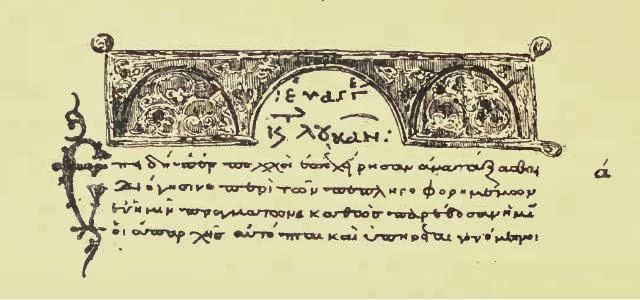
Codex 1eap (entire New Testament except Revelation, 12th century, pic above)
Codex 1rK (book of Revelation, 12th century)
Codex 2e (Gospels, 12th century)
Codex 2ap (Acts and Epistles, 12th century)
Codex 4ap (Pauline Epistles, 12th century)
Codex 7p (Pauline Epistles, 12th century)
Codex 817 (Gospels, 15th century)


The origins of all seven of these manuscripts cannot be fully deduced, but there are a handful of records that point to a few. John of Ragusa, a Dominican friar who visited Basel for one of the church councils in 1431, reportedly gifted three manuscripts to the Dominican convent at which he had lodged. Two more codices may have been on loan from the library at St. Paul's. The rest had likely been in collection at Basel for some time.


When Codex 1r (and possibly others) was missing sections, Erasmus lifted those passages from the Latin Vulgate, translated them into Greek, and inserted them into his text. This is a hotly contested choice even today, and is the source of much contention between the KJVOnlyists and the Anti-KJVOnlyists. In any case, Erasmus heavily edited his work, and subsequent editions were far more solid. Notably, the 2nd edition was used by Martin Luther in translating his 1522 German New Testament, and the 3rd edition was used by William Tyndale in his 1526 English New Testament (whose text survived despite heavy Catholic persecution, and 80% of which was carried over into the KJV's New Testament). The 3rd, 4th, and 5th editions were utilised in Robert Estienne's 1551 Editio Regia - the Textus Receptus that would serve as the primary Greek New Testament source for the next several hundred years.

Monday, December 16, 2013

Where did the term 'Lollard' come from?

Where did the term 'Lollard' come from? Interestingly, books, articles, and the internet of full of both correct and incorrect information. While Wikipedia's article on the Lollards is very thorough and slightly flawed at a few points, the section on the origins of the word itself is informative (and aligns with many of the sources that I've read):

The term is said to have been coined by the Anglo-Irish cleric, Henry Crumpe, but its exact origin is uncertain. Possibilities include:


1. From the [Middle] Dutch 'lollaerd', meaning mumbler/mutterer, from 'lollen', "to mutter/mumble".


2. The Latin 'lolium' (the name of Common Vetch or tares, as a noxious weed mingled with the good Catholic wheat).


3. The name of Lolhard, a Franciscan who converted to the Waldensian way and became an eminent preacher in Guienne. That region of France was under English control during the era he lived, and his preaching may have influenced lay English piety. He was burned near Cologne in the mid 1300s.


4. The Middle English term loller (akin to modern, albeit semi-archaic, verb loll), meaning "a lazy vagabond, an idler, a fraudulent beggar". However, this word is not recorded in this sense before 1582.


As a note, not all 'Wycliffites' were Lollards, nor were all Lollards Wycliffites. (I consider myself both.)