Friday, March 28, 2014

The Didache on: The Weekly Meeting

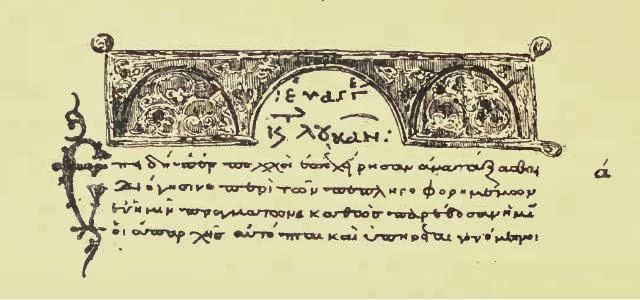
          On the heels of my last post, the weekly meeting of the church is also mentioned in The Didache, in a concise form that differs with Justin Martyr's description. As a note, The Didache - also known as The Teachings of the Twelve Apostles - was first discovered in manuscript form inside a monastery in Constantinople, in 1883. Written sometime between the late 1st and early 3rd centuries, the document likely served as a handbook for new Christians, outlining the lifestyle necessary for church membership. In his Festal Letter [39:7], Athanasius declares The Didache to be among the list of books "not included in the [Biblical] Canon, but appointed by the Fathers to be read by those who newly join us, and who wish for instruction in the word of godliness." This particular chapter would be an introduction to the church meeting, rather than a in-depth account.


"Concerning the Lord's Day"
from chapter XIV of The Didache

          On the Lord's own day gather together and break bread and give thanks, having first confessed your sins so that your sacrifice may be pure. But let no one who has a quarrel with a companion join you until they have been reconciled, so that your sacrifice may not be defiled. For this is the sacrifice concerning which the Lord said, "In every place and time offer me a pure sacrifice, for I am a great king, says the Lord, and my name is marvelous among the nations [Malachi 1:11, 14]."

Thursday, March 20, 2014

The Weekly Meeting, circa 150 AD...


          What did 'going to church' look like in Christianity's first 100 years or so? Obviously the book of Acts is our best source, but I was browsing through Henry Bettenson's Documents of the Christian Church and stumbled across a concise passage describing the weekly meeting of Christians during the 2nd century. If this description sounds similar to your church/congregation/fellowship services, you're probably on a good path.

"Weekly Worship of Christians
from chapter LXVII [67] of Justin Marty's Apology: 
          
          "Now we always thereafter remind one another of these things; and those that have the means assist them that are in need, and we visit one another continually. And at all our meals we bless the maker of all things through his son Jesus Christ and through the Holy Ghost."

          "And on the day which is called the day of the sun, there is an assembly of all who live in the towns or in the country; and the memoirs of the Apostles or the writings of the prophets are read, as long as time permits. Then the reader ceases, and the president speaks, admonishing us and exhorting us to to imitate these excellent examples. Then we arise all together and offer prayers; and as said before, when we have concluded our prayer, bread is brought, and wine and water, and the president in like manner offers up prayers and thanksgivings with all his might; and the people assent with "Amen"; and there is the distribution and partaking by all of the Eucharistic elements; and to them that are not present they are sent by the hand of the deacons. And they that are prosperous and wish to do so give what they will, each after his choice. What is collected is deposited with the president, who gives aid to the orphans and widows, and as such as are in want by reason of sickness or other cause; and to those also that are in prison, and to strangers from abroad, in fact to all that are in need he is a protector."
         
          "We hold our common assembly on the day of the sun, because it is the first day, on which God put to flight darkness and chaos and made the world, and on the same day Jesus Christ our saviour rose from the dead; for on the day before that of Saturn they crucified him; and on the day after Saturn's day, the day of the sun, he appeared to his Apostles and disciples and taught them these things, which we have also handed on to you for your consideration."


          Thus, as tradition, documents, other historical writings dictate, members of the  Christian community met on Sunday in one building or another, typically someone's home or a public or private meeting area. (There was no 'church' per se, because the body of believers IS 'the church', something Lollards fiercely adhere to.) There, they would:

- Read passages of the Old and New Testaments for "as long as time permits."

- Have the chief elder [president/presbyter] teach and exhort those present to follow the examples from the passages that had just been read.
- Have public prayer.
- Have communion.
- Take an offering for the orphans, widows, the sick and imprisoned, and other friends and strangers in need. 

Monday, March 17, 2014

Happy St. Patrick's Day!

Happy St. Patrick's Day to all my Irish friends and acquaintances, and to all those who are Irish just for one day a year! Enjoy an amazing rendition of "Danny Boy" from my favourite choir.

Wednesday, February 19, 2014

Erasmus on Greek and Bible Translation

In the previous post, I discussed the publication of the first Greek New Testament compiled by Desiderius Erasmus in 1516, and some notable aspects of its history. But what made the few Greek manuscripts in existence at the time any more legitimate than the Latin ones of the Vulgate? The idea that Greek manuscripts were more reliable than the Latin ones was a preposterous notion in the 15th and early 16th centuries, but the Dutch Humanist posed the question:

"How is it that Jerome [c.347-420 AD, translator and compiler of the original Vulgate], Augustine, and Ambrose all cite a text which differs from the [current] Vulgate? How is it that Jerome finds fault with and corrects many readings which we find in the Vulgate? What can you make of all this concurrent evidence - when the Greek versions differ from the Vulgate, when Jerome cites the text, according to the Greek versions, when the oldest Latin versions [Vetus Latina] do the same, when this reading suits the sense much better than that of the Vulgate - will you, treating all this with contempt, follow a version corrupted by some copyists?"


Erasmus also recognised that Latin was on the decline, and to hide the secrets of God's Holy Word away in a language known only to a few was a travesty. Many laymen heard short passages of the Vulgate during the mass - together with the usual orthodox interpretation - but there was no freedom to fully comprehend the intricacies of God's Word in the vernacular. While he did not personally engage in translating the Bible into any vernacular languages, Erasmus encouraged those brave individuals who did so, via his books and private letters. By the early years of the English Reformation, his Bible paraphrases and commentaries were translated into English and placed alongside the Bible in every church in England. In the preface to one of the editions of his Novum Testamentum, the scholar wrote:


"I wish that even the weakest woman should read the Gospel should read the epistles of Paul. And I wish these were translated into all languages, so that they might be read and understood, not only by the Scots and Irishmen, but also by Turks and Saracens. To make them understood is surely the first step. It may be that they might be ridiculed by many, but some would take them to heart. I long that the husbandman should sing portions of them to himself as he follows the plough, that the weaver should hum them to the tune of his shuttle, that the traveller should beguile with their stories the tedium of his journey."

Those sentences in the middle regarding translating the Bible stand out to me the most: "To make them understood is surely the first step. It may be that they might be ridiculed by many, but some would take them to heart."  

Of course there will always be men and women that shun the Bible, and (as the Catholic Church in the Middle Ages feared,) poke fun at it in taverns, inns, meeting halls, marketplaces, and in their private chambers. However, that is between them and the Lord, and the fact is that some of those men and women will hear and read the truth, and the truth will set them free. It is a personal decision that cannot be forced, nor denied by any group on earth. For that reason the Lollards spread the Gospel and gave their handwritten Middle English manuscripts to the laity; and it is for that reason Erasmus's writings inspired William Tyndale, Martin Luther, and others to translate the Greek and Hebrew testaments into the languages of their people, so that all may be able to choose to make their own personal conscious decision for Christ.

Quote sources: How Our Bible Came To Us by H.G.G. Herklots

Monday, February 3, 2014

Source Manuscripts of Erasmus's Greek New Testament

Here's some information I have reprinted from a previous blog of mine:


In 1516, Desiderius Erasmus published Novum Istrumentum Omne - the first printed Greek New Testament, and perhaps the crowning achievement of the Dutch Catholic Humanist's life. At the behest of printer Johann Froben, the work was rushed out, in competition with Cardinal Francisco Ximenez' Complutensian Polyglot, and was unfortunately riddled with printing and translation errors.

Despite issues, the tome was well received by the academic community, but scorned by many ecclesiastical authorities, citing its many departures from Latin Vulgate. Erasmus claimed that his goal in the creation of his 'New Instrument' was to revive critical interest in the Bible, whose dated 4th century Latin should updated to its original language of Greek (with a translation into Classical Latin placed alongside). Long-venerated, only recently have historians been able to examine just where much of the text originated.

Most King James Version Only'ist websites state that Erasmus (who gave us the base text of the King James Version,) used "the best manuscripts in European libraries" for his Novum Instrumentum. Research has shown that this assertion is debatable. Historian W.W. Combs, in his article "Erasmus and the Textus Receptus" (Spring 1996 Detroit Baptist Seminary Journal) asserts that Erasmus only borrowed seven manuscripts altogether, all from the Dominican library in Basel, Switzerland. None were the complete New Testament, and all were relatively young in age:


*Name, content, date.*
Codex 1eap (entire New Testament except Revelation, 12th century, pic above)
Codex 1rK (book of Revelation, 12th century)
Codex 2e (Gospels, 12th century)
Codex 2ap (Acts and Epistles, 12th century)
Codex 4ap (Pauline Epistles, 12th century)
Codex 7p (Pauline Epistles, 12th century)
Codex 817 (Gospels, 15th century)


The origins of all seven of these manuscripts cannot be fully deduced, but there are a handful of records that point to a few. John of Ragusa, a Dominican friar who visited Basel for one of the church councils in 1431, reportedly gifted three manuscripts to the Dominican convent at which he had lodged. Two more codices may have been on loan from the library at St. Paul's. The rest had likely been in collection at Basel for some time.


When Codex 1r (and possibly others) was missing sections, Erasmus lifted those passages from the Latin Vulgate, translated them into Greek, and inserted them into his text. This is a hotly contested choice even today, and is the source of much contention between the KJVOnlyists and the Anti-KJVOnlyists. In any case, Erasmus heavily edited his work, and subsequent editions were far more solid. Notably, the 2nd edition was used by Martin Luther in translating his 1522 German New Testament, and the 3rd edition was used by William Tyndale in his 1526 English New Testament (whose text survived despite heavy Catholic persecution, and 80% of which was carried over into the KJV's New Testament). The 3rd, 4th, and 5th editions were utilised in Robert Estienne's 1551 Editio Regia - the Textus Receptus that would serve as the primary Greek New Testament source for the next several hundred years.

Sunday, February 2, 2014

Layout of Bible Codices

Back when early codices were being copied down, there was no such thing as printing (obviously), so all scripture was in hand-written manuscript form. In order to save supplies and to make the tedious process of copying scripture go faster, no divisions were placed in the text — there were no spaces between words or sentences. Some "holy words" were even abbreviated, since they were repeated often. There were no chapter and verse divisions at all, just long lines of text. You can find photographs of this in many manuscripts prior to the Medieval period, evident in such texts as the Codex Alexandrinus, Amiatinus, Sinaiticus, and many others.


Scripture typically looked like the text here, taken from Acts chapter 2. As a note, our current chapter divisions were not put in until 1205 AD, under the supervision of Archbishop of Canterbury Stephen Langton. Modern verse divisions were first inserted by Robert Estienne (aka Stephanus) in the 1551 edition of his Greek New Testament.

I personally exhort fellow Christians to find a Bible that does not have any verse divisions and read through a gospel or letter in one sitting; this is the way they were 'meant' to be read, and I often get more out of those books than I do when I just read a short passage. There's not many editions like this out there, but their number is increasing.


Some Bibles without verse divisions:
- The Reader's Digest Condensed Bible (RSV)
- ESV Reader's Bible
- The Books of the Bible (NIV 2011)
- Any historical facsimile of a Bible version from the mid-1500s or prior.

Wednesday, January 22, 2014

Wycliffe on Preachers & Priests

"And I shall give to you shepherds after mine heart, and they shall feed you with knowing and teaching." - Jeremiah 3:15 (WYC LV)


Doctor Wycliffe wrote numerous pages on the topic of priests & preachers, and the importance of leading a Godly life. After all, the souls under the care of the town parish depended on them! Preaching was to be the "highest service", since it is what Christ Himself spent the majority of His ministry years doing. In fact, in book one of Opus Evangelicum Wycliffe writes, "Evangelizatio verbi est preciosior quam ministratio alicujus ecclesiastici sacramenti - The preaching of the Word is a more precious occupation than the ministration of the sacraments."


Ultimately, a preacher must illustrate all of the above in his own life, living above reproach:
"A priest should live holily, in prayer, in desires and thought, in godly conversation and honest teaching, have God's commandments and His Gospel ever on his lips. And let his deeds be so righteous that no man may be able with cause to find fault with them, and so open his acts that he may be a true book to all sinful and wicked men to serve God. For the example of a good life stirreth men more than true preaching with only the naked word."

A good pastor/preacher/priest to his flock should be...
- a whole-hearted follower of Christ
- a good and virtuous man
- a man of prayer
- a preacher of the Gospel with clarity

He should not...
- be a gambler
- be a drinker
- be a huntsman
- be a chessplayer (arguable!)

He has a three-fold duty:
1. Feed his sheep spiritually with the Word of God, introducing them to heaven like sheep being introduced to a rich pasture of perpetual greenery.
2. Purge his flock of spiritually diseased individuals who actively seek to lead others astray.
3. Defend his flock against spiritual wolves, and the fiery darts of the wicked one.

Much of what is said applies today not just to pastors, but all Christians. What better way to connect with everyone from Sunday School youth to unsaved coworkers than to lead a Godly life that reflect your faith!


Sources:
- G.R. Evans, John Wyclif: Myth & Reality, 39.
- Philip Schaff, History of the Christian Church, vol. 6, 239.
- John Wycliffe and F.D. Matthews, The English Works of Wyclif.

Further reading and exposition:
- Wycliffe's "The Pastoral Office" and "On Degrees of the Clergy".

Thursday, January 16, 2014

Formatting...

I'm working on a better format and settings for this blog, but it's a slow process, and I'm a poor judge when it comes to artistic items. I rather like the background, but I have yet to get the posts to flow well with it. All in good time I suppose!